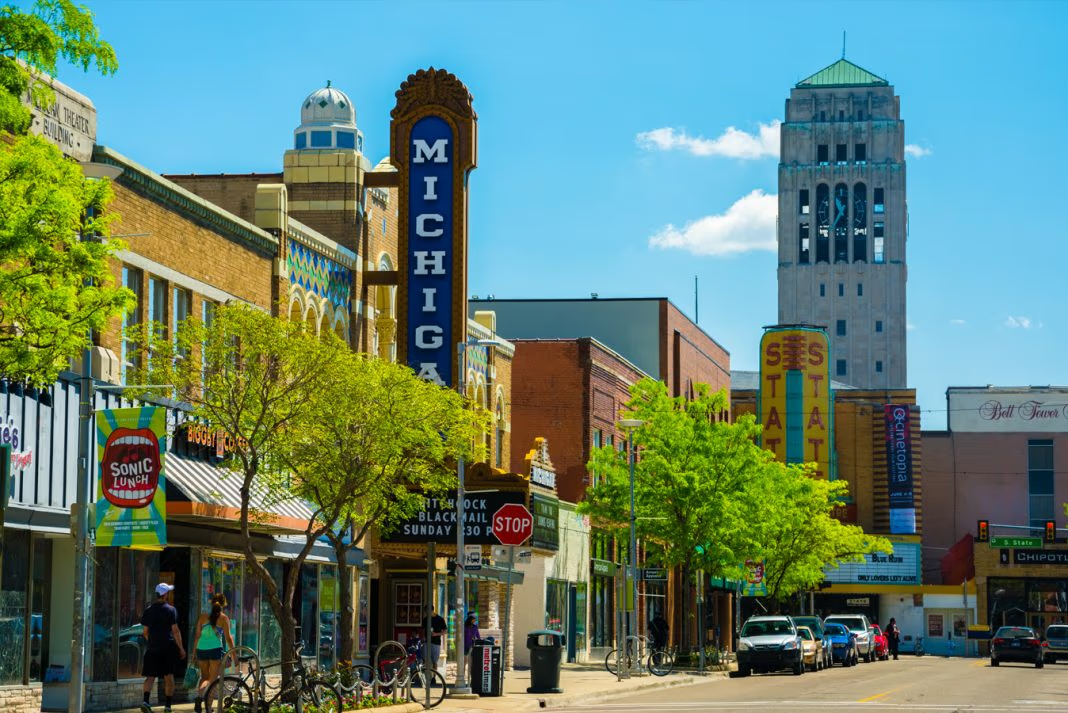
A worker hurt on the job in Ann Arbor is owed benefits under Michigan’s Workers’ Disability Compensation Act regardless of fault:
- medical care in full
- 80 percent of after-tax wages while unable to work, up to a weekly maximum
- vocational rehabilitation
- scheduled payments for the loss of a body part
What differs in Ann Arbor is the mix of employers:
- The University of Michigan, including Michigan Medicine, which employs faculty, staff, nurses, researchers, custodians, food-service workers, and many student and graduate employees.
- Other hospitals and health care, including Trinity Health Ann Arbor, clinics, nursing homes, and home-care agencies.
- Research labs and technology companies, in the research parks on the city’s edges and downtown.
- Construction, on the steady run of campus, hospital, and downtown building projects.
- Restaurants, retail, and delivery, downtown, on campus, and along the corridors.
- Public employers, including the City, Ann Arbor Public Schools, Washtenaw Community College, Washtenaw County, and TheRide.
- Federal employers, including the VA Ann Arbor Healthcare System, whose workers are covered by federal law instead.
ATLAW has practiced Michigan injury law for 13 years from its office at 3 Parklane Boulevard in Dearborn. The firm has handled more than 10,000 cases and recovered more than $100 million for clients.
- Our Michigan workers’ compensation lawyer page covers the Act in full.
- Our Ann Arbor page covers every kind of injury claim in the city.
This page covers what is particular about an Ann Arbor work injury, including the lawsuit against a third party that comp does not bar. The first conversation is free, in English, Arabic, French, Mandarin, Urdu, or Spanish: (313) 406-7606.
Michigan workers’ compensation by the numbers
| Measure | Figure | Source |
|---|---|---|
| Wage-loss benefit | 80 percent of after-tax average weekly wage | MCL 418.351, 418.371 |
| Maximum weekly benefit, 2026 injuries | $1,201 | WDCA |
| Waiting period | 7 days; paid from day one if disability lasts 14 days | MCL 418.311 |
| Employer chooses the doctor | First 28 days | MCL 418.315(1) |
| Notice to the employer | 90 days | MCL 418.381(1) |
| Claim for compensation | 2 years | MCL 418.381(1) |
| Death benefits to dependents | 500 weeks; burial up to $6,000 | MCL 418.321, 418.345 |
| Employers that must carry coverage | 3 or more employees, or 1 employee working 35 hours a week for 13 weeks | MCL 418.115 |
| Michigan fatal work injuries, most recent year | 152 (2024) | BLS, Census of Fatal Occupational Injuries, March 2026 |
Where Ann Arbor workers are hurt, and who handles the claim
The University and Michigan Medicine. The University and Michigan Medicine employ tens of thousands of people in Ann Arbor, and the injuries span every kind of work:
- patient-handling injuries to backs and shoulders from lifting and transfers
- needlesticks, exposures, and assaults by patients in the hospitals
- slips on wet floors, ice on campus walks, and falls in parking structures
- custodial, grounds, food-service, and maintenance injuries
- repetitive-strain injuries in offices and labs
A University employee’s comp claim is against the University as the employer, under the same Act, before the same agency. The University’s Work Connections office administers its employees’ claims. Because the University is the State, comp remains the exclusive remedy against it, and any separate claim against the University itself, as described below, follows the State’s rules.
Student and graduate employees. Many University workers are students: student employees in dining halls, libraries, and labs, and graduate students who teach or do research. A student who is paid as an employee is generally covered. Whether a graduate student is an employee for comp purposes can depend on how the position is classified and paid, for example as a teaching or staff assistant or on a fellowship. A student hurt in a class or an unpaid internship is usually not an employee, and the claim, if any, is an ordinary injury claim.
Research labs. Lab work produces injuries offices do not:
- chemical burns and exposures
- needlesticks and biological exposures
- animal bites and allergies in animal research
- cuts and crush injuries in machine shops and prototype labs
An exposure that causes illness over time is an occupational disease. For that kind of claim, the date of injury is generally the last day of work in the employment that caused it, and the 90-day notice runs from when the worker knew, or should have known, that the condition was work-related (MCL 418.301(1), 418.381(1)). Write down what you were exposed to, when, and in what lab.
Other hospitals, nursing homes, and home care. Nurses, aides, and technicians at Trinity Health Ann Arbor, clinics, nursing homes, and assisted living communities have the same patient-handling and exposure injuries. Health care workers’ injuries are often cumulative, and the insurer may argue the condition is degenerative rather than work-related (see “wear and tear” below). Home-care aides injured in a client’s home have a comp claim against their agency and, where a hazard in the home caused the injury, possibly a premises claim against the homeowner.
Construction. Campus, hospital, and downtown projects, and road work on the corridors and freeways, produce:
- falls from ladders, scaffolds, roofs, and openings
- struck-by and caught-between injuries, including by cranes, concrete trucks, and dump trucks
- trench collapses
- electrocutions
- work-zone injuries from passing traffic
Most construction workers are employed by a subcontractor. Their comp claim is against their own employer. A general contractor, another subcontractor, a property owner, or an equipment maker may be sued as a third party (see below). On a University project, a claim against the University is a claim against the State. It must fit an immunity exception, such as a dangerous condition of a public building (with notice within 120 days, MCL 691.1406) or a University vehicle (with notice within six months, MCL 600.6431), and both notices are filed with the Court of Claims. See our Ann Arbor truck accident page.
Restaurants, retail, and delivery. Kitchen, stock, and counter work downtown and on campus produces lifting injuries, burns, cuts, and falls, often in part-time and student jobs where injuries go unreported past the 90 days. Delivery drivers and couriers are hurt in crashes, in bike lanes, and on customers’ steps.
- Some small employers carry no workers’ compensation insurance. An uninsured employer loses the exclusive-remedy protection. The worker may claim comp benefits and may also sue the employer in circuit court, and officers can be personally liable (MCL 418.641, 418.647).
- App-based delivery drivers are often classified as independent contractors. Whether a driver is actually an employee under the Act depends on the work, not the label (MCL 418.161(1)(n)).
Technology, offices, and remote work. Office work produces fewer traumatic injuries but real ones: falls on icy walks and parking-structure ramps, and repetitive-strain injuries to wrists, elbows, and necks. Two rules matter:
- The commute. An injury on the way to or from work is generally not covered, but an injury in the employer’s parking lot or structure, or while traveling for work, generally is (MCL 418.301(3)).
- Remote work. An injury while working from home can be covered if it arose out of and in the course of the work. The facts of exactly what you were doing decide it.
Many employers offer employer-paid short- and long-term disability that is coordinated with comp (MCL 418.354).
The cap for higher earners. Comp pays 80 percent of after-tax wages only up to the state maximum, about $1,201 a week for 2026 injuries. For a physician, engineer, researcher, or manager whose after-tax pay is well above that, the benefit replaces only part of the income. Comp is still the only remedy against the employer. But if someone other than the employer caused the injury, a third-party suit recovers the full wage loss, along with pain and suffering, which comp never pays.
Public employers. The City of Ann Arbor, including police and fire; Ann Arbor Public Schools; Washtenaw Community College; Washtenaw County; and TheRide. The injuries are public-safety injuries, custodial and maintenance injuries, bus operators’ injuries, and assaults. Public employers have pension and duty-disability provisions that run alongside comp. Police officers and firefighters have a statutory presumption for certain heart and respiratory conditions (MCL 418.405).
Federal employees. Workers at the VA Ann Arbor Healthcare System, the post office, and other federal offices in the city are not covered by Michigan’s Act. Their claims fall under the Federal Employees’ Compensation Act, administered by the U.S. Department of Labor:
- a different benefit rate (two-thirds of pay, or three-quarters with a dependent)
- continuation of regular pay for up to 45 days after a traumatic injury, if the injury is reported promptly on the federal form
- a three-year deadline for the claim, with shorter deadlines for continuation of pay
- no Michigan magistrate hearing
(5 USC 8101 and following.) A federal employee hurt by someone other than the federal government, such as another driver, can still bring a third-party claim.
Drivers. Workers hurt in crashes on I-94, US-23, M-14, or the city’s corridors while working have a comp claim, and Michigan no-fault comes into the claim (see below). See our Ann Arbor car accident page.
What an Ann Arbor worker is owed
Medical care in full, for as long as needed, with no deductible or co-pay (MCL 418.315), including attendant care at home. For the first 28 days the employer chooses the doctor. After that you may treat with your own physician on notice to the employer (MCL 418.315(1)).
Wage loss at 80 percent of your after-tax average weekly wage, computed from the highest 39 of the 52 weeks before the injury (MCL 418.351, 418.371), capped at the state maximum.
- Overtime and shift premiums count toward the average weekly wage, so the pay records matter.
- If you held two jobs, as many students and health care workers do, wages from the second job may count toward the average weekly wage.
- Partial wage loss is paid if you return at lower pay (MCL 418.361(1)).
- The seven-day waiting period is paid from day one if the disability lasts two weeks (MCL 418.311).
Specific loss for a body part or its use, regardless of wage loss, which matters for amputation and eye injuries (MCL 418.361(2)). Total and permanent disability for at least 800 weeks (MCL 418.361(3)). Vocational rehabilitation up to 52 weeks, extendable to 104 (MCL 418.319).
Death benefits to dependents for 500 weeks plus burial (MCL 418.321, 418.345), alongside the third-party wrongful death claim on our Ann Arbor wrongful death page.
Where Ann Arbor claims are denied, and how they are won
- “Disability.” It means a limitation in wage-earning capacity in work suitable to your qualifications and training (MCL 418.301(4)). A written job-search log within your restrictions is the evidence (MCL 418.301(5)). For a professional or a researcher, “suitable” work is measured against your qualifications and training, which is often the dispute.
- Pre-existing conditions and wear and tear. Years on a nursing unit, in a kitchen, at a keyboard, or on a construction site produce degenerative necks, shoulders, backs, and knees. The question is whether work contributed to or aggravated the condition in a significant manner (MCL 418.301(2)). The pre- and post-injury records decide it.
- “It didn’t happen at work.” Parking-lot, travel, and work-from-home injuries are denied on this ground. The facts of where you were and what you were doing for the employer decide it.
- “You weren’t an employee.” Student workers, graduate students, delivery drivers, and staffing-agency workers are denied on this ground. The facts of the work, the pay, and the control decide it.
- Reasonable employment. Refusing a job within your restrictions without good reason can end benefits (MCL 418.301(9)). Whether an offered job is real and within your limits is a common dispute.
- The IME (MCL 418.385). The insurer’s doctor says you have recovered. Your treating physician’s records are the answer, which is why the 28-day rule matters.
- Late notice. You have 90 days from the injury, or from when you knew it was work-related (MCL 418.381(1)). A verbal report to a supervisor can satisfy the law but is hard to prove. Put it in writing and keep a copy.
- Retaliation for filing is prohibited (MCL 418.301(13)) and is a separate lawsuit.
The hearing, and the lawsuit comp does not bar
When an employer or insurer denies a claim or stops paying, the worker files an Application for Mediation or Hearing (Form WC-104A) with the Workers’ Disability Compensation Agency. Disputed claims go to mediation and then to a magistrate, with appeal to the Michigan Compensation Appellate Commission.
A contested claim often takes a year or more. That is why many disputed claims resolve by redemption, a lump-sum settlement approved by the magistrate that closes the claim, including future medical care (MCL 418.835). Do not sign one without advice.
Workers’ compensation is your exclusive remedy against an insured employer (MCL 418.131), with one narrow exception: an employer that specifically intended an injury, meaning it had actual knowledge that an injury was certain to occur and willfully disregarded that knowledge (MCL 418.131(1)).
You can sue anyone else whose negligence caused the injury (MCL 418.827):
- the other driver in a crash on the job, with workers’ compensation primary and no-fault paying the difference (MCL 500.3109(1))
- a building owner, property manager, or snow-removal contractor that is not your employer, for a fall at a leased building (Ann Arbor slip and fall page)
- a general contractor or another subcontractor on a construction job
- the manufacturer of a machine, lift, tool, or lab equipment with a missing guard or a defective safety device (product liability)
- a homeowner whose hazard injured a home-care aide or delivery worker
- a dog owner, for a delivery driver (dog bite page)
- the University, if you work for a contractor and a defective University building or a University vehicle caused the injury: a claim against the State, with notice filed with the Court of Claims within 120 days for a building (MCL 691.1406) or six months for a vehicle (MCL 600.6431)
The comp insurer has a lien on that recovery (MCL 418.827(5)), reduced by its share of fees and costs. Negotiating it is part of the work. The third-party suit is filed in the Washtenaw County Trial Court, or the 15th District Court for claims up to $25,000, within three years (MCL 600.5805(2)).
A permanent injury may also qualify for Social Security Disability, coordinated with comp under the federal offset (42 USC 424a). An employer-provided long-term disability plan, usually governed by ERISA, may pay too. See our Ann Arbor Social Security Disability page and long-term disability page.
What to do after a work injury in Ann Arbor
- Report it in writing the same day, to your supervisor and to HR or the employer’s claims office, and keep a copy. That includes a fall in the parking structure and an exposure in the lab.
- Get treatment, with the employer’s designated provider for the first 28 days if required, and tell every provider exactly how the injury happened at work.
- Count 28 days. On day 29, if you are not satisfied with the employer’s doctor, see your own and notify the employer in writing.
- If you were placed by a staffing agency, or work for a contractor on someone else’s site, report to both companies, and keep the names of both.
- Keep your pay stubs and W-2s from every job, including overtime, shift premiums, and bonuses. Once released with restrictions, keep a written log of every job you apply for.
- Do not give a recorded statement to the adjuster without advice, and do not sign a redemption agreement without understanding that it ends your medical coverage.
- If a machine, a contractor, a driver, a building owner, or the University as a third party was involved, call within days. The third-party evidence disappears on the same schedule as in any injury case, and a claim against the University has a 120-day or six-month notice.
Deadlines for Ann Arbor work injury claims
| What | When | Statute |
|---|---|---|
| Notice to the employer | 90 days from the injury or from when you knew it was work-related | MCL 418.381(1) |
| Claim for compensation | 2 years | MCL 418.381(1) |
| Benefits recoverable before the claim was filed | 2 years before the hearing application; 1 year for nursing or attendant care | MCL 418.381(2), (3) |
| Third-party injury suit | 3 years | MCL 600.5805(2) |
| Third-party claim against the University or the State | Notice filed with the Court of Claims: 120 days for a building defect, 6 months otherwise | MCL 691.1406, 600.6431 |
| No-fault notice (crash on the job) | 1 year | MCL 500.3145(1) |
| Suit against an uninsured employer | 3 years | MCL 418.641; 600.5805(2) |
| Federal employee’s claim | 3 years; prompt report for continuation of pay | 5 USC 8122 |
| Wrongful death (third party) | 3 years, with the estate’s savings provision | MCL 600.5805(2), 600.5852 |
Why Ann Arbor workers call ATLAW
- 13 years of Michigan injury practice; more than 10,000 cases; more than $100 million recovered.
- Claims handled against large employers and their claims administrators, including student, graduate, staffing-agency, and uninsured-employer cases.
- Both claims handled together: the comp claim before the agency and the third-party suit in the Washtenaw County Trial Court, with the lien negotiated at the end.
- Comp, no-fault, employer disability, and Social Security coordinated so the benefits do not cancel each other out.
- Fees set by state rule and approved by the magistrate; nothing up front, nothing unless benefits are recovered.
- Consultations can be accommodated in English, Arabic, French, Mandarin, Urdu, and Spanish. We welcome clients to our Dearborn office for a consultation. If you are unable to visit, home or hospital visits can be arranged as needed.