For twenty years, a fall on someone else’s property in Michigan was close to unwinnable. If the hazard was “open and obvious,” the property owner owed you no duty, and the case ended before it began. That rule is gone. In July 2023 the Michigan Supreme Court overruled it in Kandil-Elsayed v. F & E Oil, and a slip and fall claim now turns on the questions it should have turned on all along: did the owner know about the hazard, did they do anything about it, and how much of the fall was your fault.
If you were hurt in a fall and were told, or assumed, that you had no case, that may no longer be true. This page explains the rules as they stand now.
ATLAW is a personal injury firm in Dearborn. In 13 years the firm has handled more than 10,000 cases and recovered more than $100 million for clients across Wayne, Oakland, Macomb, and Washtenaw counties. Fall cases are handled on contingency: no fee unless we recover money for you, and the first conversation is free.
What changed in 2023, and why it matters to your case
Under the old rule (Lugo v. Ameritech, 2001), a property owner had no duty to protect visitors from a danger an average person would have noticed: a wet floor, a pothole in a parking lot, ice on a walkway. Because almost every hazard is visible in hindsight, insurers used the rule to deny most fall claims outright, and courts dismissed most of the ones that were filed.
In Kandil-Elsayed v. F & E Oil, Inc. (Michigan Supreme Court, July 28, 2023), the Court held that whether a hazard was open and obvious no longer decides whether the owner owed a duty. It is now one factor in two other questions: whether the owner breached the duty of reasonable care, and how much fault, if any, belongs to the person who fell. Both are questions for a jury.
In practice: a grocery store that left a spill on the floor for an hour cannot win the case by saying the spill was visible. A jury decides whether the store should have cleaned it up and whether you should have seen it. If the jury assigns you some of the fault, your recovery is reduced by that share. If it assigns you more than half, you recover no damages for pain and suffering (MCL 600.2959). That is the fight in a Michigan fall case now, and it is a fight that can be won.
What you have to prove in a Michigan slip and fall case
1. The owner owed you a duty. Michigan sets the duty by why you were on the property.
- Invitee: you were there for the owner’s commercial benefit, as a customer, patient, tenant in a common area, or guest of a business. The owner must inspect the property, fix dangers it finds, and warn of the ones it cannot fix. This is the highest duty and covers most falls.
- Licensee: a social guest in a home. The owner must warn of hidden dangers it knows about, but need not inspect.
- Trespasser: the owner must only refrain from willful or wanton harm.
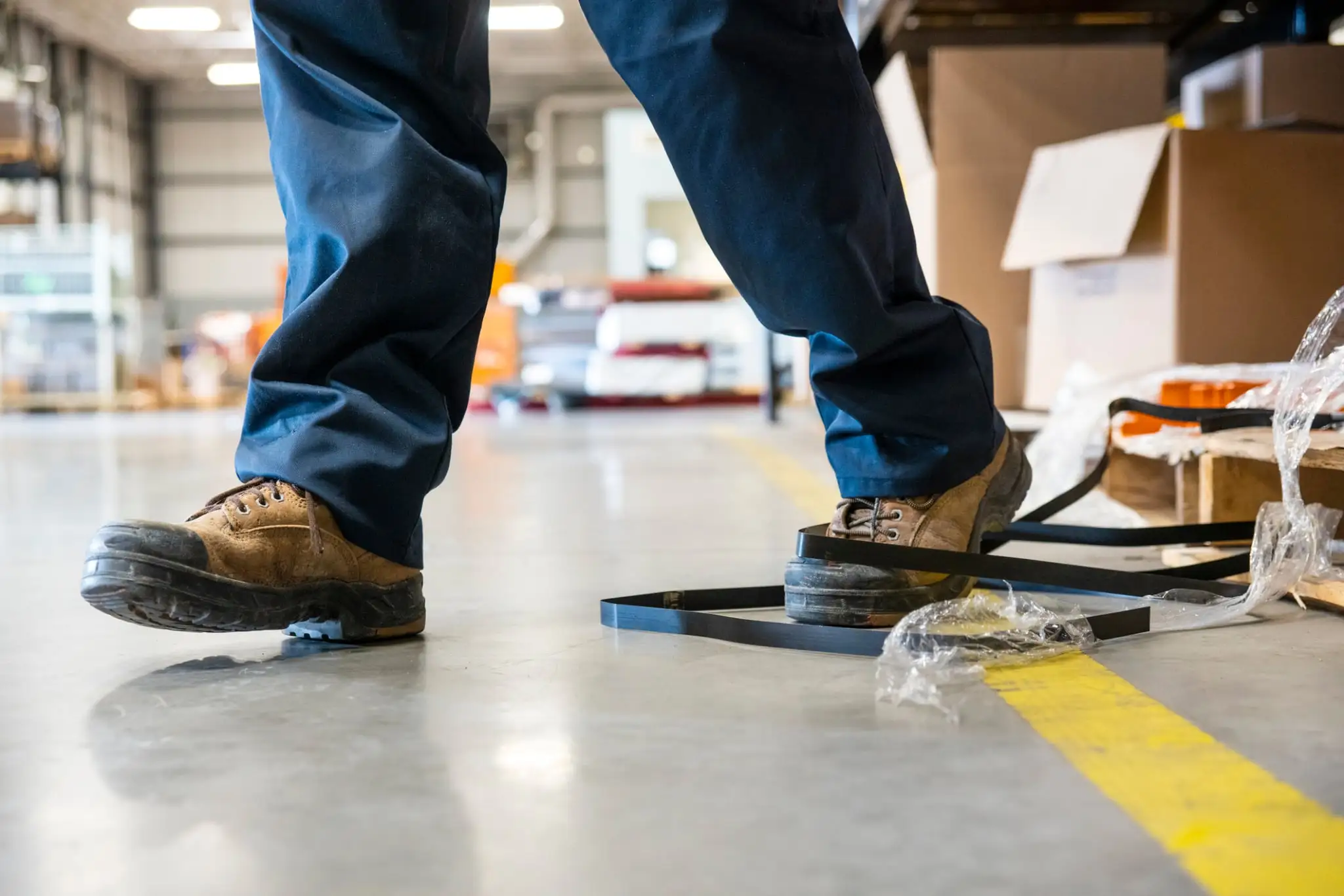
2. There was a dangerous condition. A wet or recently mopped floor, a spill, ice or snow, a broken step, an unmarked change in floor level, a loose mat, a pothole in a parking lot, inadequate lighting, a missing handrail, a protruding display.
3. The owner knew or should have known about it. This is where most cases are decided. “Actual notice” means an employee saw it or caused it. “Constructive notice” means the hazard existed long enough that a reasonably careful owner would have found it. A spill that happened thirty seconds before you fell is hard to pin on the store; one with cart tracks through it and dried edges is not. Store surveillance footage, cleaning logs, and incident reports are the evidence, and the owner controls all three, which is why a lawyer requests them in writing immediately.
4. The condition caused your injury, and you suffered real damages: medical bills, lost wages, pain, and the lasting effects.
Snow and ice falls in Michigan
Winter falls are the most common fall case in metro Detroit and the most contested. The rules:
- A property owner must take reasonable steps, within a reasonable time after snow or ice accumulates, to make walkways safe. “Reasonable” depends on the facts: a store open to the public at 9 a.m. after an overnight storm is expected to have salted its entrance; a homeowner is not expected to shovel during a blizzard.
- After Kandil-Elsayed, the owner cannot defeat the claim by arguing the ice was visible. The question is what they did about it and whether you had a realistic alternative route. Ice covering the only path from the parking lot to the door is a strong case; ice in a corner nobody needed to cross is not.
- Black ice that formed from refreezing meltwater or a leaking downspout is a condition the owner created, and those cases are stronger than natural accumulation.
- For tenants, Michigan’s landlord statute (MCL 554.139) requires the landlord to keep common areas fit for their intended use. The Michigan Supreme Court has held that a parking lot with one to two inches of snow is still “fit” for parking (Allison v. AEW Capital, 2008), so tenant snow cases depend on whether the accumulation actually prevented the use of the area.
Falls on public property: sidewalks, parks, and government buildings
If you fell on a city sidewalk, in a county building, at a public school, or on state property, different and harsher rules apply, and the deadline is short.
- Government immunity protects cities, counties, and the state from most injury claims. The exceptions that apply to falls are the highway exception, which covers sidewalks and crosswalks (MCL 691.1402), and the public building exception (MCL 691.1406).
- The two-inch rule (MCL 691.1402a): a sidewalk defect less than two inches high is presumed to be reasonable repair. You can rebut the presumption, but a raised slab under two inches is a difficult case. Measure it and photograph it with a ruler before it is repaired.
- Notice within 120 days (MCL 691.1404, 691.1406): you must serve written notice on the right government body, stating the injury, the exact location and nature of the defect, and the names of witnesses. Miss it and the claim is gone regardless of how clear the defect was.
- Detroit, Dearborn, and most Wayne County cities place sidewalk repair responsibility on adjacent property owners by ordinance, which can make the private owner a defendant too.
If you fell on public property, call within days, not months.
Where falls happen in metro Detroit
- Grocery and big-box stores on Ford Road, Telegraph, Michigan Avenue, Gratiot, and Hall Road: spills, produce sections, entrance mats in winter.
- Restaurants and bars: wet floors near restrooms and kitchens, poorly lit steps.
- Apartment complexes and rental homes in Dearborn, Detroit, Hamtramck, and Southfield: broken stairs, missing handrails, unlit common areas, unplowed lots. These are landlord cases under MCL 554.139.
- Parking lots and parking structures: potholes, wheel stops, ice, uneven drainage grates.
- Hospitals, nursing homes, and medical offices, where a fall by a patient may be a premises case, a nursing home negligence case, or both.
- Malls (Fairlane, Somerset, Twelve Oaks, Great Lakes Crossing) and hotels.
- Construction zones and sidewalks under repair.
Falls are the leading cause of injury-related emergency room visits for adults over 65, and a hip fracture in that age group is a life-changing injury. ATLAW handles fall cases for older clients and their families with that in mind.
What to do after a slip and fall in Michigan
- Report it before you leave, to the manager, the landlord, or the property owner, and ask for a written incident report. Get a copy or photograph it. A fall that was never reported is a fall the insurer will say never happened.
- Photograph the hazard immediately, from several angles, with something for scale. The spill gets mopped and the ice melts within the hour; the photo is the case. Photograph your shoes and the clothes you were wearing.
- Get witness names and phone numbers, including employees. Note the time; it matters for constructive notice.
- Get medical care the same day. Fall injuries (fractures, torn ligaments, concussions, back injuries) are often worse than they feel in the first hour, and a record dated that day is what connects the injury to the fall.
- Write down what happened while it is fresh: what the surface looked like, whether there were warning signs or cones, what employees said. “We’ve been meaning to fix that” is evidence.
- Do not give a recorded statement to the property owner’s insurer and do not post about the fall. “I wasn’t looking where I was going” in a text to a friend has ended cases.
- Call a lawyer quickly. Surveillance footage is typically overwritten in 7 to 30 days. A preservation letter puts the recipient on notice to retain relevant evidence. For public property, the 120-day notice clock is already running.
What a Michigan slip and fall case is worth
- The injury. Fractures requiring surgery, torn knees and shoulders, head injuries, and spinal injuries drive value; a bruise that resolves in a week rarely justifies a claim, and we will say so.
- Economic losses: medical bills, lost wages, future care. In a fall case these are paid by the owner’s liability insurer, not by no-fault.
- The strength of notice evidence: footage, logs, prior complaints, prior falls at the same spot.
- Comparative fault: the percentage the insurer can credibly assign to you. Footwear, distraction, and whether warning signs were up all matter.
- The owner’s insurance limits: commercial premises policies are typically $1 million or more; a homeowner’s policy is usually $100,000 to $500,000.
Michigan places no cap on pain and suffering damages in a premises case. ATLAW’s results: more than 10,000 cases and more than $100 million recovered for clients in 13 years, across all injury practice areas. Every case is different and past results do not predict yours.
Deadlines
| Deadline | Applies to | Source |
|---|---|---|
| Days | Preservation letter for surveillance footage (commonly overwritten in 7–30 days) | Practice |
| 120 days from the fall | Written notice for a fall on a sidewalk, road, or public building owned by a city, county, or the state | MCL 691.1404, 691.1406 |
| 3 years from the fall | Lawsuit against a private property owner, business, or landlord | MCL 600.5805(2) |
| 3 years from the death | Wrongful death from a fall | MCL 600.5805, 600.5852 |
If the injured person is a minor, the clock generally runs until at least a year after their 18th birthday (MCL 600.5851).
Why people in metro Detroit call ATLAW after a fall
A Dearborn firm that takes fall cases seriously. ATLAW evaluates every fall under the law as it stands now. The office is at 3 Parklane Blvd., Suite 400W, Dearborn, MI 48126; the attorney who meets you handles your case.
More than 10,000 cases, more than $100 million recovered in 13 years, across all injury practice areas. Every case is different; the figures show the firm has done this work against these insurers.
Preservation letter in the first days. Footage and logs are requested in writing before they can be lost.
Honest evaluation. Some falls are not cases: no notice, a minor injury, or more than half the fault on the person who fell. We will tell you which yours is, for free, in the first conversation.
No fee unless we win. A contingency fee set in writing before we start. ATLAW advances case costs, so you pay nothing up front; the 33.3% attorney fee is calculated on the recovery after those costs are deducted, and if there is no recovery you owe no fee and no costs.
English, Arabic, French, Mandarin, Urdu, and Spanish. Consultations, intake, and case updates in the language you are most comfortable in.