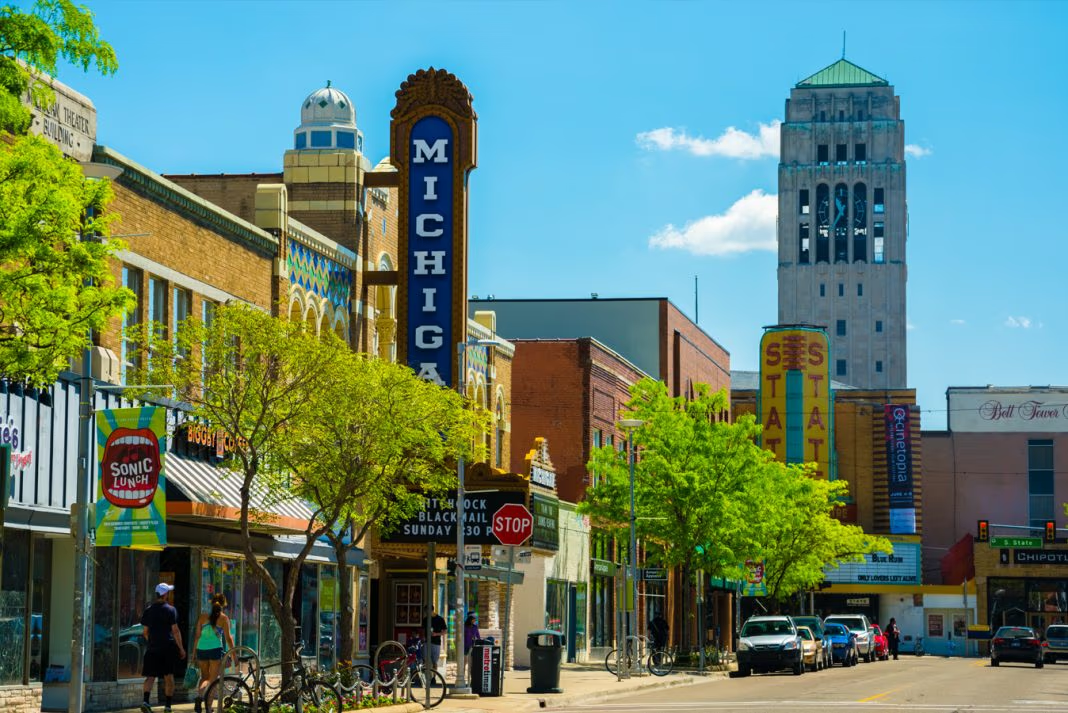
A car crash in Ann Arbor is a Michigan no-fault claim on these roads:
- Campus and downtown streets: State Street, South and East University, Washtenaw Avenue at the Hill, Packard, Liberty, Main, Huron, Division, and Fuller and Observatory by the medical campus. They carry more people on foot and on bikes than any other streets in Washtenaw County.
- The corridors: Washtenaw Avenue, Stadium Boulevard, Packard, Plymouth Road, Jackson Avenue, Huron Parkway, and Ellsworth, with roundabouts at State and Ellsworth and elsewhere.
- The freeways: I-94 on the south, US-23 on the east, and M-14 on the north, with interchanges at State, Ann Arbor-Saline, Jackson, Washtenaw, Plymouth, and Main.
In 2024, the Michigan State Police recorded 2,770 crashes in Ann Arbor, more than in any other community in Washtenaw County. 5 people were killed, 36 were seriously injured, and 540 were injured in all. 56 crashes involved pedestrians and 68 involved bicyclists, about three of every four bicyclist crashes in the county.
An Ann Arbor crash claim usually turns on four questions:
- Fault at the crosswalk, the roundabout, or the ramp. Ann Arbor’s own crosswalk rule can decide it.
- Who pays your no-fault benefits. For a student, that may be a parent’s policy.
- The other driver’s insurance. How much they had, and how your own uninsured and underinsured motorist coverage fits with it.
- Whether a public body is involved. If the road, a bus, or a vehicle belonged to the City, MDOT, TheRide, or the University of Michigan, the court and any notice deadline depend on which one.
ATLAW has practiced Michigan injury law for 13 years from its office at 3 Parklane Boulevard in Dearborn, about 35 miles east on I-94. The firm has handled more than 10,000 cases and recovered more than $100 million for clients.
- Our Michigan car accident lawyer page covers the law in full.
- Our Washtenaw County car accident page covers the county.
- Our Ann Arbor page covers every kind of injury claim in the city.
The first conversation is free, in English, Arabic, French, Mandarin, Urdu, or Spanish: (313) 406-7606.
Ann Arbor and Washtenaw County crashes, 2024
| Measure | Figure | Source |
|---|---|---|
| Ann Arbor crashes / fatal crashes / injury crashes | 2,770 / 5 / 423 | MSP, Michigan Traffic Crash Facts 2024, Washtenaw County profile |
| Ann Arbor people killed / seriously injured / injured in all | 5 / 36 / 540 | Same |
| Crashes on interstate routes / U.S. routes / state routes / other roads | 652 / 163 / 64 / 1,888 | Same |
| Pedestrian / bicyclist / alcohol / drug / deer-involved crashes | 56 / 68 / 63 / 21 / 71 | Same |
| Ann Arbor’s share of Washtenaw County pedestrian / bicyclist crashes | 56 of 100 / 68 of 91 | Same |
| Neighbors, for comparison: Ypsilanti / Ypsilanti Twp. / Pittsfield Twp. crashes | 838 / 1,069 / 1,143 | Same |
| State Street at Ellsworth (roundabout) | 85 crashes, 5 injuries; second in Washtenaw County | MSP 2024 crash data, as compiled and reported November 2025 |
| Huron Parkway at Washtenaw Avenue / Packard at Platt | 35 crashes, 15 injuries / 31 crashes, 6 injuries | Same |
| Washtenaw County crashes / killed / seriously injured | 9,844 / 35 / 197 | MSP 2024 |
| Michigan liability limits for the at-fault driver | $250,000 / $500,000 unless the driver chose lower limits; minimum $50,000 / $100,000 | MCL 500.3009(1), (5) |
The numbers show the city’s pattern:
- Pedestrians and cyclists. Ann Arbor had more than half of the county’s pedestrian crashes and three-quarters of its bicyclist crashes.
- The roundabout. It had the most crashes of the three intersections but the fewest injuries. Huron Parkway at Washtenaw had fewer crashes and three times the injuries.
Where Ann Arbor crashes happen
Campus and downtown: pedestrians, cyclists, and scooters. The crashes are:
- drivers turning right or left across a crosswalk into a pedestrian (MCL 257.612, 257.650)
- the multiple-threat crash: one driver stops for a pedestrian, and the driver in the next lane does not
- cyclists struck by a right-turning vehicle, or by a door opened into a bike lane
- scooter and e-bike riders struck at intersections and driveways
- drivers backing out of on-street spaces and driveways in the near-campus neighborhoods
Ann Arbor’s crosswalk rule. At a crosswalk without a working traffic signal, the city’s ordinance (City Code chapter 126, section 10:148) requires a driver to stop for a pedestrian in a crosswalk. It also requires the driver to stop before entering the crosswalk when a pedestrian is standing at the curb or the start of the crosswalk waiting to cross. That goes further than state law. A driver who violated it is evidence of negligence in the pedestrian’s claim. See our pedestrian accident and bicycle accident pages.
The roundabouts. The roundabout at State Street and Ellsworth, near Briarwood and the I-94 interchange, had 85 crashes in 2024, the second-most of any intersection in the county. Most were minor; 5 caused injuries. The crashes are:
- a driver entering without yielding to traffic already in the circle
- a driver changing lanes or exiting from the wrong lane in a two-lane roundabout
- rear-end crashes at the entries
- pedestrians and cyclists struck at the crossings
The corridors. Washtenaw Avenue, Stadium, Packard, Plymouth, Jackson, Huron Parkway, and Ellsworth carry the city’s commuter and retail traffic. Huron Parkway at Washtenaw Avenue had 35 crashes and 15 injuries in 2024. The crashes are:
- left-turn crashes across oncoming lanes
- red-light crashes
- rear-end crashes in the turn lanes
- driveway crashes at the strips and shopping centers (MCL 257.652)
The freeways and interchanges. I-94, US-23, and M-14 ring the city. The crashes are:
- rear-end and lane-change crashes in the backups at the interchanges
- merge crashes on short ramps
- truck crashes
See our Ann Arbor truck accident page.
Football Saturdays and big events. Home games at Michigan Stadium bring crowds of more than 100,000 people into the stadium neighborhood. Streets close, shuttles run, and pedestrians fill roads not built for them. The crashes are pedestrians struck in the crowds, drivers leaving tailgates and bars after drinking, and congestion crashes on Main, Stadium, and the freeways.
Whose road it is: the City, MDOT, the University, or the Washtenaw County Road Commission
Ann Arbor is a city and owns its streets, but four public owners share the roads:
- The City of Ann Arbor owns the city streets and sidewalks. A claim for a road, signal, or sidewalk defect requires written notice within 120 days (MCL 691.1402, 691.1402a, 691.1404).
- MDOT owns I-94, US-23, M-14, and any state trunkline routes through the city. A road-defect claim goes to the Court of Claims, with written notice filed there within 120 days (MCL 691.1404).
- The University of Michigan owns its campus roads, drives, and parking structures. A claim against it is a claim against the State (see below).
- The Washtenaw County Road Commission owns the county’s primary and local roads outside the city limits.
When the other vehicle belongs to the University of Michigan
The University of Michigan is a constitutional state institution. A crash with a University bus, a University-owned vehicle, or a University police car is a claim against the State, under the motor vehicle exception to governmental immunity (MCL 691.1405). That changes three things:
- The court. The claim is filed in the Michigan Court of Claims and decided by a judge, not a jury.
- The notice. Written notice, or the claim itself, must be filed within six months of the crash (MCL 600.6431). Missing it can end the claim, even though the ordinary deadline is three years.
- The individual. A claim against an individual University employee raises separate questions.
A crash with a TheRide bus (the Ann Arbor Area Transportation Authority) is also a claim under the motor vehicle exception, against the authority, in the circuit court. See our bus accident page.
Fault is the case
In a rear-end crash, fault is rarely disputed. At a crosswalk, a roundabout, a bike lane, or a freeway merge, it often is. The other driver’s insurer may try to assign you half or more of the fault, and that share matters (MCL 500.3135(2)(b)):
- More than 50 percent at fault: you lose your claim for pain and suffering. It is barred, not merely “limited.”
- 50 percent or less: your recovery is reduced by your share. At exactly 50 percent, you recover half.
The evidence that decides fault is perishable:
- the Ann Arbor Police Department crash report, the University’s Division of Public Safety and Security report for a crash on campus, or the State Police report for a crash on a freeway
- the City’s or MDOT’s signal timing data
- cameras at businesses, apartment buildings, and University buildings, many overwritten within days
- the vehicles’ event data recorders, which store speed, braking, and throttle in the seconds before impact
- the other driver’s phone records, for a distracted-driving claim (see our distracted driving page)
- witnesses, including other pedestrians and cyclists
For a pedestrian, the crosswalk ordinance and the signal phase are often the deciding evidence. We move promptly to request the camera footage, signal data, and vehicle data.
Who pays after an Ann Arbor crash
Your no-fault (PIP) claim. Your own auto insurer pays these benefits regardless of fault (MCL 500.3107):
- your medical expenses, up to the PIP level you chose
- 85 percent of lost wages for up to three years, up to the monthly cap DIFS sets each year
- replacement services at $20 a day
- attendant care
The PIP level is not the same as your liability limits. Since July 2, 2020, Michigan drivers choose a PIP medical level for each policy: unlimited, $500,000, $250,000, $50,000 for some Medicaid enrollees, or an opt-out for some Medicare enrollees (MCL 500.3107c). That choice is separate from the liability limits that protect the other driver.
Students. Many students do not own a car. A student hit while walking, biking, or riding in someone else’s car claims no-fault benefits in this order (MCL 500.3114, 500.3115, 500.3172):
- a policy in the student’s household, which may be a parent’s policy if the student is still domiciled with the parent
- if none applies and the student was riding in a car, the insurer of that car (MCL 500.3114(4)) 3. otherwise, including a student hit while walking or biking, the Michigan Assigned Claims Plan, capped at $250,000 for medical benefits (MCL 500.3115(1))
Whether a student living in Ann Arbor is still domiciled with a parent depends on the facts.
Out-of-state students and visitors. A crash in Ann Arbor with an out-of-state driver, or involving a student from another state, still follows Michigan’s no-fault rules. Insurers that sell auto insurance in Michigan must provide Michigan benefits for a crash here.
Scooters and e-bikes. A scooter or e-bike rider hit by a car is generally treated like a pedestrian or cyclist for no-fault purposes, with benefits from the household policy or, if none, the Michigan Assigned Claims Plan. A rider who falls with no car involved generally has no no-fault claim.
Bus passengers. A passenger hurt on a TheRide or University bus claims benefits under the bus-passenger priority rules (MCL 500.3114(2)).
The insurer must receive written notice within one year (MCL 500.3145(1)). It must pay each bill within 30 days of reasonable proof, or owe 12 percent interest (MCL 500.3142). See our no-fault insurance claim page and our Michigan no-fault guide.
If you had no insurance. A person who owned a car and was required to insure it, but did not, is generally barred from PIP benefits for their own injuries (MCL 500.3113(b)). A driver who was operating their own uninsured vehicle cannot recover pain-and-suffering damages, whoever was at fault (MCL 500.3135(2)(c)).
Your claim against the at-fault driver. For pain and suffering, you need a threshold injury: death, serious impairment of body function, or permanent serious disfigurement (MCL 500.3135(1)). A serious impairment is an objectively manifested impairment of an important body function that affects your general ability to lead your normal life. It does not have to be permanent (MCL 500.3135(5); McCormick v Carrier, 2010).
You can also recover economic losses that no-fault does not cover (MCL 500.3135(3)(c)):
- lost wages beyond the three years or above the monthly cap
- medical bills above your chosen PIP level
The suit must be filed within three years (MCL 600.5805(2)). The mini tort claim recovers up to $3,000 in vehicle damage not covered by your policy (MCL 500.3135(3)(e)). If the at-fault driver’s insurer will not pay it, the claim is filed in the 15th District Court.
When the other driver has no insurance, or not enough. Some drivers carry only the $50,000 opt-down minimum (MCL 500.3009(5)), and some carry nothing.
- Against an uninsured driver: your pain-and-suffering claim is worth what that driver can personally pay, unless you carry uninsured motorist coverage. A hit-and-run is usually a UM claim, with short notice terms in the policy.
- Against an underinsured driver: your own underinsured motorist coverage pays the difference up to your UIM limit, if you follow the steps in order:
- The at-fault driver’s insurer offers its limit.
- You notify your own insurer and ask for its written consent to settle.
- Only then do you accept the limit and sign the release.
- The UIM claim then proceeds.
Accepting without consent can forfeit the UIM claim under many policies. A student may be covered by UM or UIM under a parent’s policy as a resident relative. See our uninsured motorist page.
Drunk drivers and the dram shop claim. A bar, restaurant, or store that serves a visibly intoxicated person, or a minor, is liable for the injuries that person causes (MCL 436.1801). The State Police recorded 63 alcohol-involved crashes in Ann Arbor in 2024. In a college town, service to minors is part of many of these claims. Written notice must go to the business within 120 days after you hire a lawyer, the drunk driver must be named and kept in the suit, and the suit must be filed within two years. See our drunk driving accident page.
What to do after an Ann Arbor crash
- Call 911 and get the police report. Michigan requires a report for any crash with injury or $1,000 in damage (MCL 257.622). City streets are worked by the Ann Arbor Police Department, campus streets by the University’s Division of Public Safety and Security, and the freeways by the State Police or the Sheriff.
- Photograph the scene: the vehicles, plates, the other driver’s license and insurance card, the crosswalk, signal, roundabout, or ramp, and the lane markings. Note every building with a camera facing the scene. Footage is kept for days, not weeks.
- Get medical care the same day. University of Michigan Health is a Level I trauma center for adults and children, and Trinity Health Ann Arbor is a Level I trauma center.
- If a University vehicle or bus was involved, write down the vehicle number and tell us at once. The six-month Court of Claims notice is already running.
- Report to your own insurer, or your parents’ insurer if you are a student, and file the Application for No-Fault Benefits promptly.
- Read the declarations pages for the PIP medical level, UM/UIM, and collision coverage, including a parent’s policy.
- Do not give a recorded statement to the other driver’s insurer, sign a release, or accept a policy-limits offer before your UIM insurer consents.
- Call a lawyer within days if fault is disputed, the other driver is uninsured, a public body is involved, or a bar served the driver.
Our full checklist covers the first day, week, month, and year.
The courts
- Claims up to $25,000, including mini tort claims, go to the 15th District Court at the Ann Arbor Justice Center, 301 East Huron Street.
- Injury suits over $25,000 go to the Washtenaw County Trial Court (22nd Circuit) at 101 East Huron Street, with a jury drawn from Washtenaw County.
- Claims against the University of Michigan, MDOT, or the State go to the Michigan Court of Claims.
- Cases against out-of-state defendants may be filed in, or removed to, the U.S. District Court for the Eastern District of Michigan, which sits in Ann Arbor as well as Detroit.
- A fatal crash is brought by the estate, opened through the Washtenaw County Probate Court. See our Ann Arbor wrongful death page.
Deadlines for Ann Arbor crash claims
| What | When | Statute |
|---|---|---|
| Claim against the University of Michigan, MDOT, or the State | 6 months; 120 days for a road defect | MCL 600.6431, 691.1404 |
| Written notice of injury to your no-fault insurer | 1 year | MCL 500.3145(1) |
| UIM consent before accepting the at-fault driver’s limit | Before you sign | Policy terms |
| Hit-and-run or UM claim notice | Per policy; often short | Policy terms |
| Dram shop claim | Notice within 120 days of hiring a lawyer; suit within 2 years | MCL 436.1801(3) |
| Road, signal, or sidewalk defect on a City of Ann Arbor street | Written notice within 120 days | MCL 691.1402, 691.1402a, 691.1404 |
| Suit against the at-fault driver | 3 years | MCL 600.5805(2) |
| Injured child | 3 years, or one year after the 18th birthday if later | MCL 600.5851(1) |
Why Ann Arbor crash victims call ATLAW
- 13 years of Michigan injury practice, more than 10,000 cases, and more than $100 million recovered.
- The right defendant and the right court identified promptly: a private driver, the City, MDOT, TheRide, or the University in the Court of Claims, with each notice calendared.
- Every household policy read, including a parent’s policy for a student, before the claim is valued.
- The liability limit and the UIM claim sequenced so that neither is forfeited.
- Camera, signal-data, and vehicle-preservation requests sent promptly.
- No attorney fee or case costs unless we recover money for you. The first conversation is free.
- Consultations can be accommodated in English, Arabic, French, Mandarin, Urdu, and Spanish. We welcome clients to our Dearborn office for a consultation. If you are unable to visit, home or hospital visits can be arranged as needed.