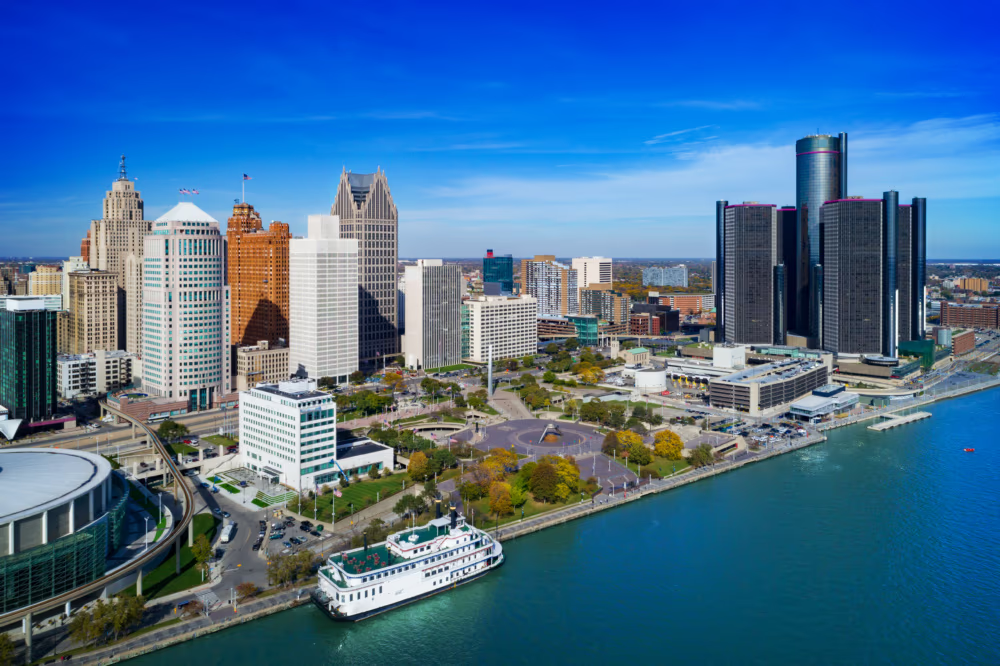
A motorcycle crash in Pontiac is governed by a rule many riders learn only after they are hurt: under Michigan no-fault, a motorcycle is not a “motor vehicle.” That definition decides who pays your medical bills, how much they pay, whether you have a no-fault claim at all, and how the insurer will argue the helmet question. Pontiac adds its own risks: drivers changing lanes across the one-way Woodward Loop without seeing a rider in the next lane; drivers turning left across Telegraph and Huron Street; freeway merges on M-59 and I-75; work zones as MDOT converts the Loop and the downtown streets to two-way traffic; potholes and broken pavement on city streets; and three road agencies, the State, the City, and the Road Commission, which decides where the notice goes when the road caused the crash.
ATLAW has practiced Michigan injury law for 13 years from its office at 3 Parklane Boulevard in Dearborn, has handled more than 10,000 cases, and has recovered more than $100 million for clients. Our Michigan motorcycle accident lawyer page covers the no-fault rules for riders in full, our Pontiac page covers every kind of injury claim in the city, and our Pontiac car accident page covers crashes between cars. The first conversation is free: (313) 406-7606.
Motorcycle crashes by the numbers, 2024
| Measure | Figure | Source |
|---|---|---|
| Motorcycle crashes in Oakland County / riders injured / killed | 310 / 219 / 16 | MSP, Michigan Traffic Crash Facts 2024, Oakland County |
| Michigan motorcycle crashes / riders injured / killed | 3,187 / 2,460 / 168 | MSP, 2024 Motorcycle Crash Facts |
| Share of Michigan rider deaths involving alcohol | 31 percent | MSP 2024 |
| Oakland County crashes / injured / killed, all vehicles | 35,951 / 9,139 / 68 | MSP, Michigan Traffic Crash Facts 2024 |
| Michigan liability limits for the at-fault driver | $250,000 / $500,000 unless the driver chose lower limits; minimum $50,000 / $100,000 | MCL 500.3009(1), (5) |
| Medical coverage required to ride without a helmet (age 21+) | $20,000 first-party medical | MCL 257.658 |
Where Pontiac motorcycle crashes happen
The Woodward Loop. Traffic on the Loop moves one way, several lanes wide, and drivers cross several lanes to reach their exits for downtown, Woodward south, Huron Street, and the neighborhoods. A driver checking a mirror for a car misses a motorcycle in the next lane, and the rider is sideswiped or cut off. Pontiac is also the northern end of the Woodward Dream Cruise each August, bringing heavy classic-car and motorcycle traffic to Woodward.
The left turn on Telegraph and Huron Street. A driver turning left across oncoming traffic, misjudging the speed of a motorcycle or not seeing it at all, is the recurring account in rider cases. Under Michigan law a driver must yield to oncoming traffic before turning left (MCL 257.650). On Telegraph the turning driver crosses several lanes, often looking past a stopped vehicle in the opposite turn lane that hides an approaching rider, at Orchard Lake, Elizabeth Lake, Square Lake, and Huron and at the shopping-center driveways. On Huron Street (M-59), the same left turns happen at Perry, Opdyke, and Baldwin.
M-59 and I-75. On the freeways, drivers merging and changing lanes, and rear-end crashes in congestion near the interchanges, are the rider’s risks; a rear-end impact a car absorbs throws a rider. Trucks serving the warehouses and plants on the city’s east side add blind spots. See our Pontiac truck accident page.
Work zones. MDOT plans to convert Pike Street and Cass Avenue to two-way traffic in fall 2026, to close Huron Street between the two sides of the Loop from spring to fall 2027, and to begin converting the Loop itself in 2028, under its current schedule. Work zones are especially dangerous on two wheels: milled and grooved pavement, uneven lane edges, steel plates, loose gravel, temporary lane shifts, and drivers following old traffic patterns. A crash caused by an unsafe work zone can involve the contractor as well as MDOT, though MDOT answers only for a defect in the roadbed itself, such as an unsecured steel plate or broken pavement, not for signs or lane shifts.
City streets. Perry, Baldwin, Joslyn, Opdyke, Walton, Saginaw, and the neighborhood streets carry signal crashes, crashes at stop signs where a driver rolls through, and single-vehicle crashes caused by potholes, broken pavement, and raised utility covers.
The road itself. A single-vehicle crash caused by a pothole, a broken joint, a pavement drop-off, a steel plate left by road work, or loose gravel from a defective repair is a claim against the agency with jurisdiction under the highway exception to governmental immunity (MCL 691.1402). In Pontiac that can be one of three agencies:
- MDOT for Woodward, the Loop, Telegraph, M-59, and I-75: written notice filed with the Court of Claims within 120 days (MCL 691.1404).
- The City of Pontiac for most city streets: written notice within 120 days (MCL 691.1404).
- The Road Commission for Oakland County for roads it maintains within the city, by segment: written notice within 120 days (MCL 691.1404).
A defect that was readily apparent to an ordinary observer for 30 days or more is conclusively presumed known to the agency (MCL 691.1403). Notice to the wrong agency is not notice, so the jurisdiction over the exact segment has to be confirmed before the notice goes out.
Bars and restaurants. 31 percent of Michigan’s 2024 rider deaths involved alcohol. A downtown bar or restaurant that over-served the driver who hit a rider can be liable under the dram shop act: written notice within 120 days after you hire a lawyer, and suit within two years (MCL 436.1801(3)). See our drunk driving accident page.
Who pays a Pontiac rider’s medical bills
If a car or truck was involved, you have no-fault benefits, but not from your motorcycle insurer. Under MCL 500.3114(5), your Personal Injury Protection benefits come, in order, from:
- the insurer of the owner or registrant of the motor vehicle involved;
- the insurer of that vehicle’s operator;
- the motor vehicle insurer of the motorcycle’s operator;
- the motor vehicle insurer of the motorcycle’s owner or registrant.
“Involved” does not require contact; a car that cut across the Loop and forced you down is involved even if it never touched you. If no insurer in that chain exists, the Michigan Assigned Claims Plan pays (MCL 500.3172), with its $250,000 medical cap, unless you owned the motorcycle and it was uninsured (MCL 500.3113(b)).
The benefits are the ones a driver would get under MCL 500.3107: medical expenses up to the PIP limit on the policy that pays, 85 percent of lost wages for up to three years up to the monthly cap DIFS sets each year, $20 a day in replacement services, attendant care, and mileage. Written notice is due within one year (MCL 500.3145(1)). See our no-fault insurance claim page.
The first medical limit is set by a policy you did not choose. Since the 2019 reform, the PIP medical level on the policy first in priority pays first; if the driver who hit you chose $250,000, that policy pays up to $250,000, and a lower-priority policy with more coverage, such as your own car policy, may then pay the rest.
If no car or truck was involved, no-fault does not apply. A single-vehicle crash on a pothole, a steel plate, gravel, or a deer produces no PIP claim. Your bills go to your health insurance and any medical coverage you bought on the motorcycle policy, and your injury claim is against whoever caused the hazard, if anyone did. A rider hit by a car, by contrast, usually has a full PIP claim, and which insurer pays it is the first question.
Your motorcycle. Your own collision or comprehensive coverage pays for the bike. The mini tort claim does not cover a motorcycle, because a motorcycle is not a “motor vehicle” under the no-fault act (Nerat v Swacker, 150 Mich App 61, 1986).
Your claim against the driver who hit you
For pain and suffering and economic losses beyond no-fault, you sue the at-fault driver if your injury is a serious impairment of body function, permanent serious disfigurement, or death (MCL 500.3135(1)). Motorcycle injuries clear that threshold more often than car injuries: fractures, road rash requiring grafts, torn ligaments, brain injuries, and spinal cord injuries. You also recover excess economic damages above the PIP limit that applied to you, and wage loss above the no-fault cap or beyond three years (MCL 500.3135(3)(c)). You have three years to sue (MCL 600.5805(2)); a fatal crash is brought by the estate (see our wrongful death page).
What the claim is worth depends on the other driver’s policy. Liability limits on Pontiac’s roads range from the $50,000 opt-down minimum (MCL 500.3009(5)) to large policies, and some drivers carry nothing. The recovery then turns on your own uninsured and underinsured motorist coverage, which must be on the motorcycle policy; many car policies exclude the insured while riding an owned motorcycle. See our uninsured motorist page.
Comparative fault is the fight. Above 50 percent at fault you recover no noneconomic damages; below that your award is reduced by your share, and at exactly 50 percent you recover half (MCL 500.3135(2)(b), 600.2959). Economic damages beyond no-fault are reduced by your share as well. Insurers argue speed, lane position, lane splitting (illegal in Michigan), and “came out of nowhere.” The Sheriff’s report, witnesses, the other driver’s phone records, store and gas-station cameras along Telegraph and Huron Street, MDOT cameras on the freeways, and the rider’s own camera answer it.
The helmet question
Since 2012, Michigan has let riders 21 and older ride without a helmet if they carry at least $20,000 in first-party medical coverage and have either held a motorcycle endorsement for two years or passed an approved safety course (MCL 257.658). Riders under 21 must wear a helmet. If you met those conditions, riding helmetless was legal, so it was not a traffic violation. In a head-injury case the insurer will argue a helmet would have reduced the injury, which is a damages argument for the jury, not a bar; in a leg or shoulder case it is irrelevant.
What to do after a Pontiac motorcycle crash
- Get medical care the same day. McLaren Oakland and Trinity Health Oakland, both in Pontiac, are Level II trauma centers on the State’s list; the most serious injuries may go to Corewell Health William Beaumont University Hospital in Royal Oak, the county’s Level I adult trauma center.
- Get the police report from the Oakland County Sheriff’s Office, which polices Pontiac under contract (online through CLEMIS, typically 7 to 10 business days after the crash, or from the Sheriff’s Records Unit on North Telegraph), or from the State Police on the freeways. If a car caused the crash without contact, make sure the report says so.
- Identify every vehicle involved, including the one that never touched you.
- Photograph the bike, the scene, the intersection, lane, or work zone, the road surface and any pothole, plate, or gravel, your gear, and your injuries, and note every business and home with a camera facing the road. Do not repair or sell the bike.
- Read your motorcycle policy for first-party medical, UM/UIM, and collision coverage, and your car policy’s PIP level.
- Apply for no-fault benefits with the right insurer within the first week, and do not give a recorded statement to the other driver’s insurer.
- If a road defect was involved, call within days. The 120-day notice to the City or the Road Commission is already running.
The courts and deadlines
Rider injury suits over $25,000 go to the Sixth Judicial Circuit Court at 1200 N. Telegraph Road in Pontiac; smaller claims to the 50th District Court at 70 N. Saginaw Street; claims against MDOT to the Court of Claims.
| What | When | Statute |
|---|---|---|
| Written notice to the responsible no-fault insurer | 1 year | MCL 500.3145(1) |
| Hit-and-run or UM claim notice | Per policy; often short | Policy terms |
| Road defect claim against the City of Pontiac or the Road Commission | Written notice within 120 days | MCL 691.1404 |
| Defect on Woodward, the Loop, Telegraph, M-59, or I-75 (MDOT) | Notice filed with the Court of Claims within 120 days | MCL 691.1404 |
| Dram shop claim | Notice within 120 days of hiring a lawyer; suit within 2 years | MCL 436.1801(3) |
| Suit against the at-fault driver | 3 years | MCL 600.5805(2) |
Why Pontiac riders call ATLAW
- 13 years of Michigan injury practice; more than 10,000 cases; more than $100 million recovered.
- Every vehicle involved and every policy in the priority chain identified before the no-fault application is filed.
- The road agency identified before the notice runs: MDOT, the City, or the Road Commission.
- No fee unless we recover money for you. The first conversation is free.